Synths ⇝ Korg ⇝ Korg M1
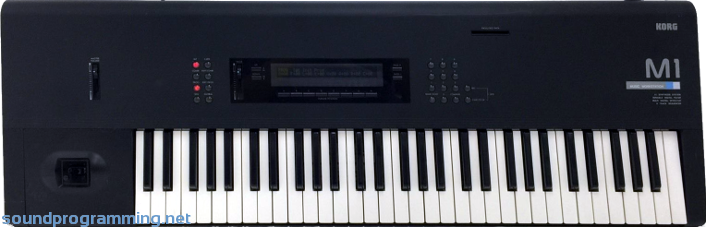
The M1 is one of the first fully-sample-based digital synthesizer workstations, using what Korg calls "AI Synthesis". It was very popular, selling about 250,000 units during its production lifetime.
The internal sample ROM can also be expanded with the EXK-M1 ROM expansion kit, doubling the wave memory to 8MB with 275 PCM samples. It also has two card slots - one for a waveform card and one for a patch memory card, and a large library of expansion cards was released by Korg and other third-party manufacturers.
The M1 is also available in 2U rackmount format as the M1R. It was followed by the T series, which included the Korg T1, T2, and T3 and then later the 01/W.
It uses a standard CR2032 lithium battery to maintain its memory.
Specifications
Year Released: 1988
MSRP: 2166.00 USD
Keyboard: 61 keys with velocity and aftertouch
Polyphony: 16 notes
Multitimbral: 8 parts
User Patches: 100
ROM: 4MB at 16-bit resolution (100 multisamples, 44 drum samples)
Effects: 2 effects processors with reverb, delay, chorus, EQ, overdrive, flanger, and rotary speaker
Screen: 40 x 2 character backlit LCD
Power Consumption: 11 watts
Dimensions: 1058 mm x 356 mm x 110 mm
Weight: 13.5 kg
Sequencer: 8 Tracks, 10 Songs, 100 Patterns, 4400 notes. Memory mode can be switched to expand the sequencer to 7700 notes as the cost of 50 patch and 50 combination memories.
User Demo Videos
Rating
Sound Samples
WAV samples are available on freewavesamples.com.
File Downloads
The Sound Programming site is copyright © 2006-2026 Jason Champion.